There are many different styles of horseback riding. Many equestrians enjoy trail riding because it is adventurous and exciting. It is a way to escape the hard work of riding in a ring, practicing for a horse show, or taking lessons. Trail riding is good for horses too because it is an escape from the routine ring work. Many Olympic level horses are on intense training programs that involve a day of trail riding. It allows the horse and rider to clear their heads and enjoy freedom and exhilaration. The feeling of galloping a horse through the woods is indeed wonderful.
However, trail riding can be dangerous since the horse and rider are not in a confined area. Important safety tips include wearing a helmet, being alert for approaching people or dogs, and riding a horse you trust. Especially if riding with a group of people it is essential to be cautious. If something scares one of the horses, such as a barking dog or a falling branch, many times all of the horses will sense the fear, and this can cause them to run. It is the fight or flight instinct of the herd. A galloping herd of horses can be difficult to control and stop, even for the most advanced riders. Check out this link for more information on trail safety .
Monday, March 24, 2008


Wednesday, March 19, 2008
Horse Talk
Training horses can be difficult and challenging, yet I love the process of developing trust and communication with these giant beasts. I had an experience a few months ago that is well worth sharing. The horse in training was an older buckskin named Cisco. Buckskin refers to the color of the horse. It is a creamy color with black legs and mane and tail. He is named after the horse in Dances With Wolves.
While most horses in training are young, Cisco is about fifteen. This age is not that old for a horse, but he is definitely set in his ways. Even though younger horses are often more spirited, they are sometimes easier to train than older, wiser horses. Cisco was a new addition to our barn, and the previous owner said that he had been ridden a few times, but was still not very broke. This turned out to be quite the understatement.
On this particular day, I was teaching a lesson to a group of beginners while Rusty and Pam were attempting to ride Cisco. They manage to get the saddle on him, but he is refusing the bit. The bit is probably the most important part of tacking up a horse. The bit goes in their mouth and enables the rider to have control and communication. Rusty begins to get frustrated because Cisco is not behaving. When horses are confused they often get scared. This fear causes them to buck, kick, rear, or even bite. Trained horses very rarely, if ever, act this way towards humans. Cisco, however, had begun to sweat and was trying to run in circles. Rusty tied Cisco to a tree, hoping he would calm down. He continued to paw out at the air and neigh very loudly. There were several people watching and wondering what would happen next.
I finished teaching my lesson and walked over to Cisco. He jerked his head up and looked at me with wide eyes. I untied him from the tree and walked him to the middle of the field we were in. I had the bridle in my hands. I slowly reached my hand over his ears and tried to get the bit in his mouth. He jerked his head up so fast that both of my feet came off the ground! I knew what to try next: twitching. Twitching means to grab a horse's ear and gently, yet firmly, twist it and hold it. It doesn't hurt the horse, but it calms them. It releases endorphins and relaxes them into submission. It is very similar to a mother cat who picks her kittens up by the scruff of their neck, causing them to go limp. I had to have Rusty hold his ear while I attempted to get the bit in his mouth. It worked!
Next, I had to try and get on Cisco. He was prancing around and still neighing very loudly. I decided to lunge him to get some of his energy out. Lunging means to let the horse run in large circles around you by attaching a long rope to the bridle. Cisco was not very good at this, and I had to keep trying over and over again for him to understand. He kept looking at me with that wild eyed look of panic. If he could talk, he would have said, "I am so confused. What am I supposed to do?" Finally, he got the idea and began to lunge correctly.
I took the lead off of him, and put my left foot in the stirrup very slowly. Just as I attempted to swing my right leg over, he reared straight up in the air. I managed to get my foot out of the stirrup. We repeated this several times. He continued to get frustrated as I did. I stopped and took a deep breath. I knew something had to give or we would make no progress. I walked over to Cisco, and I looked right at him. I put my hand on his head and began to talk to him very softly. He looked wary at first, but then he turned his head and looked right back at me. As I continued to stroke him, he slowly lost the wild-eyed look. I squatted down to the
ground, and he lowered his head towards me. I felt hopeful.
There is a horse term called "Joining Up." Joining up is a natural approach to training horses. Basically, it is when the horse finally realizes that you are in control and also understands that he needs you to be in control. It is similar to becoming the pack leader in a group of dogs or in a herd of wild horses. The horse undergoes an enlightening moment of trust, and he will do anything that you want him to. I, personally, had very little experiences with this concept, but I could tell that I was very close to making this happen with Cisco.
I stood up from the ground, and he didn't move a muscle. I put my left foot in the saddle, and I swung my right leg over. I was in the saddle! Cisco tensed up, but he didn't move. I got right off and gave him lots of praise. Then I got back on and off several times, ensuring that we had made progress. I got off of him and let go of the reins and started walking away from him. He followed me! When I turned, he turned. If I stopped, he stopped. It was amazing. I got back on him, and I rode him around for several minutes, practicing stopping and turning. I even layed across the saddle, and he stood perfectly still.
I have ridden horses for many years, and this experience was one of the greatest equine moments of my life. To see a horse like Cisco undergo such an intense change in less than an hour, was a sight to behold. He was truly like a different horse. It reminded me about the beauty of communication and loyalty between animals and humans. As soon as Cisco understood what I wanted, not only did he comply, but he transformed into a loyal and loving friend.
While most horses in training are young, Cisco is about fifteen. This age is not that old for a horse, but he is definitely set in his ways. Even though younger horses are often more spirited, they are sometimes easier to train than older, wiser horses. Cisco was a new addition to our barn, and the previous owner said that he had been ridden a few times, but was still not very broke. This turned out to be quite the understatement.
On this particular day, I was teaching a lesson to a group of beginners while Rusty and Pam were attempting to ride Cisco. They manage to get the saddle on him, but he is refusing the bit. The bit is probably the most important part of tacking up a horse. The bit goes in their mouth and enables the rider to have control and communication. Rusty begins to get frustrated because Cisco is not behaving. When horses are confused they often get scared. This fear causes them to buck, kick, rear, or even bite. Trained horses very rarely, if ever, act this way towards humans. Cisco, however, had begun to sweat and was trying to run in circles. Rusty tied Cisco to a tree, hoping he would calm down. He continued to paw out at the air and neigh very loudly. There were several people watching and wondering what would happen next.
I finished teaching my lesson and walked over to Cisco. He jerked his head up and looked at me with wide eyes. I untied him from the tree and walked him to the middle of the field we were in. I had the bridle in my hands. I slowly reached my hand over his ears and tried to get the bit in his mouth. He jerked his head up so fast that both of my feet came off the ground! I knew what to try next: twitching. Twitching means to grab a horse's ear and gently, yet firmly, twist it and hold it. It doesn't hurt the horse, but it calms them. It releases endorphins and relaxes them into submission. It is very similar to a mother cat who picks her kittens up by the scruff of their neck, causing them to go limp. I had to have Rusty hold his ear while I attempted to get the bit in his mouth. It worked!
Next, I had to try and get on Cisco. He was prancing around and still neighing very loudly. I decided to lunge him to get some of his energy out. Lunging means to let the horse run in large circles around you by attaching a long rope to the bridle. Cisco was not very good at this, and I had to keep trying over and over again for him to understand. He kept looking at me with that wild eyed look of panic. If he could talk, he would have said, "I am so confused. What am I supposed to do?" Finally, he got the idea and began to lunge correctly.
I took the lead off of him, and put my left foot in the stirrup very slowly. Just as I attempted to swing my right leg over, he reared straight up in the air. I managed to get my foot out of the stirrup. We repeated this several times. He continued to get frustrated as I did. I stopped and took a deep breath. I knew something had to give or we would make no progress. I walked over to Cisco, and I looked right at him. I put my hand on his head and began to talk to him very softly. He looked wary at first, but then he turned his head and looked right back at me. As I continued to stroke him, he slowly lost the wild-eyed look. I squatted down to the
ground, and he lowered his head towards me. I felt hopeful.
There is a horse term called "Joining Up." Joining up is a natural approach to training horses. Basically, it is when the horse finally realizes that you are in control and also understands that he needs you to be in control. It is similar to becoming the pack leader in a group of dogs or in a herd of wild horses. The horse undergoes an enlightening moment of trust, and he will do anything that you want him to. I, personally, had very little experiences with this concept, but I could tell that I was very close to making this happen with Cisco.
I stood up from the ground, and he didn't move a muscle. I put my left foot in the saddle, and I swung my right leg over. I was in the saddle! Cisco tensed up, but he didn't move. I got right off and gave him lots of praise. Then I got back on and off several times, ensuring that we had made progress. I got off of him and let go of the reins and started walking away from him. He followed me! When I turned, he turned. If I stopped, he stopped. It was amazing. I got back on him, and I rode him around for several minutes, practicing stopping and turning. I even layed across the saddle, and he stood perfectly still.
I have ridden horses for many years, and this experience was one of the greatest equine moments of my life. To see a horse like Cisco undergo such an intense change in less than an hour, was a sight to behold. He was truly like a different horse. It reminded me about the beauty of communication and loyalty between animals and humans. As soon as Cisco understood what I wanted, not only did he comply, but he transformed into a loyal and loving friend.
Sunday, March 9, 2008
Giddy Up!
Several people have asked where there are places to ride in Georgia. So, I thought it would be helpful to create a post about the best places to hit the saddle in the local area. As regular visitors of Journey of The Horse are already aware, there are many different types of horseback riding. In order to simplify the search for local stables, I have separated it into three categories: Therapeutic riding, Hunter/Jumper riding lessons, and trail riding. In addition to the information listed on this post, there are links to each stable in a column on the right side of Journey of the Horse, titled Local Riding Stables.
When beginning the sport of horseback riding, it is important to trust the people and the horses of the stable. Some things to consider are the safety and quality of the horses and the experience of the instructors. Horseback riding can be dangerous if not handled with the utmost delicacy and caution. The stables listed below are all very qualified to meet the needs of beginner equestrians. Hopefully this post will encourage you to begin your own journey of the horse!
Therapeutic Riding
Green Acres Equestrian Center
Woodstock, GA
770-517-5154
Chastain Horse Park
Atlanta, GA
404-252-4244
Dreampower Therapeutic
Alpharetta, GA
770-740-8083
Hunter/Jumper Lessons
Falcon Ridge Stables
Woodstock, GA
770-516-1981
Legend's Run
Woodstock, GA
770-645-0000
Sonora Creek
Canton, GA
770-569-9118
Trail Riding
Adventure Trail Rides
Blue Ridge, GA
706-258-BARN
Georgia Guest Ranch
Waleska, GA
770-479-9707
Southern Cross Guest Ranch
Madison, GA
706-342-8027
When beginning the sport of horseback riding, it is important to trust the people and the horses of the stable. Some things to consider are the safety and quality of the horses and the experience of the instructors. Horseback riding can be dangerous if not handled with the utmost delicacy and caution. The stables listed below are all very qualified to meet the needs of beginner equestrians. Hopefully this post will encourage you to begin your own journey of the horse!
Therapeutic Riding
Green Acres Equestrian Center
Woodstock, GA
770-517-5154
Chastain Horse Park
Atlanta, GA
404-252-4244
Dreampower Therapeutic
Alpharetta, GA
770-740-8083
Hunter/Jumper Lessons
Falcon Ridge Stables
Woodstock, GA
770-516-1981
Legend's Run
Woodstock, GA
770-645-0000
Sonora Creek
Canton, GA
770-569-9118
Trail Riding
Adventure Trail Rides
Blue Ridge, GA
706-258-BARN
Georgia Guest Ranch
Waleska, GA
770-479-9707
Southern Cross Guest Ranch
Madison, GA
706-342-8027
Thursday, February 28, 2008
Healing Power of Horses

Recently, I lived in Maine for two years. In 2006, I lived alone on a farm in a small town called Windham, Maine. The name of the farm is Riding to the Top. I have a link to this farm on the bottom right of Journey of the Horse, titled Therapeutic Riding. I was the caretaker of the horses, and I also helped teach the lessons. These lessons are much different than the hunter/jumper lessons I teach today and have taught most of my life. All of the students are handicapped, either physically or mentally. Many of them are paralyzed or have Downs syndrome or severe Attention Deficit Disorder or Hyperactivity issues. We had very safe and well-trained horses that could handle these types of lessons. It is also imperative to be extremely patient and kind during these lessons.
One specific day, I was teaching Tony, a ten year old with Downs syndrome. He was riding a horse named Teddy, who indeed looks like a fuzzy brown teddy bear with giant kind eyes. Tony and I were working on sitting up tall in the saddle and not slouching over, as he tended to do. Tony was slouched over and not smiling very much. I kept reminding him to sit up tall, but he was not concentrating very much. All of a sudden, Tony slides right off of Teddy! Thankfully, we were only walking, and I knew he was not injured. Teddy leans his head down and gently sniffs Tony, who is lying in shock on the ground. Tony looks up at Teddy and lets out a huge smile and laughs hysterically. So, maybe riding didn't made Tony smile, but falling off certainly did. I help Tony back on Teddy, and he is beaming with a giant silly smile. I can not help but smile back. Tony sits up tall and straight as a board for the rest of his lesson.
Sometimes, the healing power of horses comes in small doses. It is not always about jumping high or training a young horse. Often, it is just a gentle nudge from a horse or a feeling of happiness as you connect with these giant beasts. Thanks Tony for reminding me about the simple joy of horseback riding!
Friday, February 22, 2008
Jumping Lessons

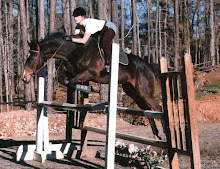
This is a picture of one of my students, Victoria, jumping her horse Aladdin. They jumped 4 feet today! That is a big jump, and they have worked very hard to accomplish such a goal. Victoria has been riding several years, but Aladdin is a green horse. Green means that he does not have a lot of training, and he is new to the world of hunter/jumpers. Victoria usually takes three to four lessons a week on him, and they have become quite the team. Most of our lessons include teaching Aladdin how to listen to Vicotoria's aids. Aids are the use of a rider's leg, seat, voice, or body movements in order to effectively communicate with the horse. Aladdin has learned to understand what certain aids mean, and this knowledge is what assisted him and Victoria over this big jump! Our goals for the future are to jump an entire course of big jumps. A course is a series of jumps, usually eight to twelve, jumped consecutively without stopping. Courses are much more challenging than single jumps because the rider must remember where to go next, and the horse has to keep his pace and momentum consistent the whole time.
Monday, January 21, 2008
The Wide World of Horses
There are many different styles of horseback riding. This post aims to give a short overview or introduction of the ones we will discuss in Journey of the Horse. If you are new to the world of horses, these terms will hopefully educate you. Again, please feel free to ask questions. If you are already an equine enthusiast, please add your expertise or opinions!
Hunters are the graceful and elegant horses of the horse show. These horses are judged on their style of jump, ability to jump, manners and evenness of pace. The horse and rider must exhibit these qualities on the course, over jumps, between jumps, and through the turns.
Jumpers provide the thrills of the horse show. The purpose of the jumper is to clear the obstacles without faulting. Style, action, conformation or pace is not considered in the judging. Ultimately, the horses' speed and jumping ability are the only considerations for winning an event.
Therapeutic riding teaches horsemanship that stimulates physical, mental and emotional growth. Many therapeutic riders are unable to walk, have Downs Syndrome, or some other form of mental or physical handicap. These riders are often greatly rewarded by the wonderful pleasures of horseback riding!
Horse training involves an in-depth communication between horse and rider. The goal is to teach a young or inexperienced horse how to perform correctly when being ridden. The trainer must be a confident and wise equestrian in order to be successful at horse training. Training is not for the beginner!
Teaching riding lessons is a wonderful way to share knowledge and passion to a new rider. Most riders take one to two lessons a week in order to progress. There are many different ways to teach lessons, and it is often different for each instructor/student. A lot of the techniques depend on the horse and rider's personalities and goals.
Now that we have a basic understanding of the differences between hunter/jumper, therapeutic riding, teaching, and training we can begin to examine these in depth!
Let the fun begin!
Hunters are the graceful and elegant horses of the horse show. These horses are judged on their style of jump, ability to jump, manners and evenness of pace. The horse and rider must exhibit these qualities on the course, over jumps, between jumps, and through the turns.
Jumpers provide the thrills of the horse show. The purpose of the jumper is to clear the obstacles without faulting. Style, action, conformation or pace is not considered in the judging. Ultimately, the horses' speed and jumping ability are the only considerations for winning an event.
Therapeutic riding teaches horsemanship that stimulates physical, mental and emotional growth. Many therapeutic riders are unable to walk, have Downs Syndrome, or some other form of mental or physical handicap. These riders are often greatly rewarded by the wonderful pleasures of horseback riding!
Horse training involves an in-depth communication between horse and rider. The goal is to teach a young or inexperienced horse how to perform correctly when being ridden. The trainer must be a confident and wise equestrian in order to be successful at horse training. Training is not for the beginner!
Teaching riding lessons is a wonderful way to share knowledge and passion to a new rider. Most riders take one to two lessons a week in order to progress. There are many different ways to teach lessons, and it is often different for each instructor/student. A lot of the techniques depend on the horse and rider's personalities and goals.
Now that we have a basic understanding of the differences between hunter/jumper, therapeutic riding, teaching, and training we can begin to examine these in depth!
Let the fun begin!
Subscribe to:
Posts (Atom)